· Marc Price · revenue-operations · 10 min read
From 10 Tools to 1 System: Building Your AI-Powered Revenue Operations Stack
Martech has hit peak sprawl - 15,505 products, half of them unused. Here's the architecture that replaces the stack with a system, and where AI actually fits in it.
TL;DR
Martech has hit peak sprawl: the 2026 State of Martech landscape counts 15,505 commercial products, and for the first time in fifteen years that number has barely moved. The problem was never a shortage of tools - it is that teams actively use only 49% of what they have bought. Bolting an AI agent onto that mess does not fix it; it launders it, producing confident answers from data nobody trusts. The fix is architectural, not another purchase: build a single unified data layer underneath your CRM, engagement and reporting tools, then let AI agents plug into that layer once it is clean. Ten tools do not need to become one tool. They need to become one system.
Why Has the Martech Stack Stopped Growing?
Because it hit a wall, not a plateau by design.
For fifteen straight years the martech landscape only ever went one direction: up. Scott Brinker’s State of Martech 2026 report, produced with Frans Riemersma’s MartechTribe, counted 15,505 commercial products this year - up from 15,384 in 2025. That is 0.79% growth, effectively flat, the first stall since Brinker started counting back when the landscape held 150 tools.
Underneath the flat headline the real story is churn, not calm: 1,488 new products arrived while 1,367 were removed. Buyers are not shopping less. They are finally being made to choose - and “another tool” has stopped being an acceptable answer to a real problem.
Why Do Teams Only Use Half of What They Already Bought?
Because most stacks were assembled tool by tool, not designed as a system.
The numbers are stark. MarTech’s 2026 State of Your Stack survey found that only 49% of martech tools are actively used - and just 15% of organisations qualify as high performers who get genuine value from their portfolio. Gartner’s own survey put overall stack capability utilisation even lower, at 33% - with complexity, patchy customer data and inflexible governance the top-cited blockers, not budget.
The tool is rarely the problem. The system it sits inside is.
What Should Replace “The Stack”?
Not a bigger stack. A unified data layer that the tools plug into.
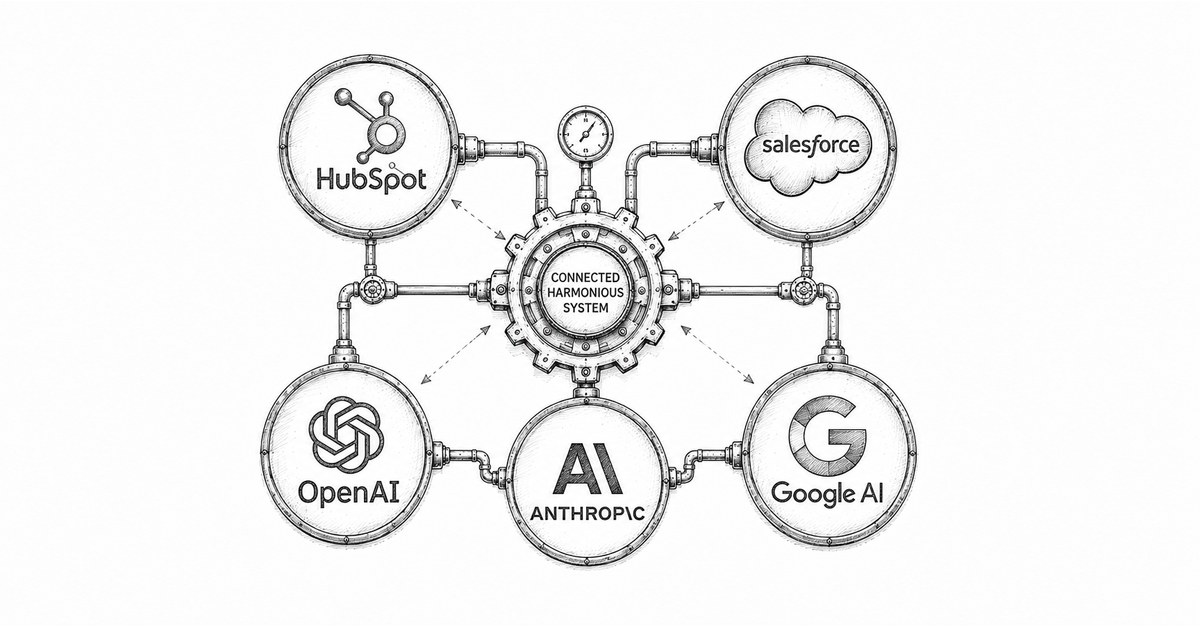
In March 2026, Brinker published a research report with Databricks - The New Martech Stack for the AI Age - arguing that the rigid, vertically layered stack of the last two decades is giving way to a composable canvas: one data foundation underneath, with applications and AI agents plugging in on top, rather than each tool holding its own island of data and syncing it awkwardly to the others.
This is the architectural answer to the problem we set out in The Integration Playbook: native connectors, iPaaS and reverse-ETL are the how. A unified data layer is the destination those methods are meant to serve, rather than a permanent patchwork of point-to-point syncs.
For most mid-market teams this shows up practically as a composable CDP: build the customer data layer directly on the warehouse you already run - Snowflake, BigQuery or Databricks - and let your tools read from and write to it, instead of buying a packaged platform that copies everything into its own silo. One caution, though: 77% of companies still rate their own data quality as average or worse. A composable architecture does not fix bad data. It just gives bad data a faster route to every tool in your stack.
Where Does AI Actually Fit In?
On top. Once the layer underneath is trustworthy, and not a day before.
Gartner’s October 2025 survey found 45% of martech leaders say the vendor-sold AI agents they have piloted do not meet expectations, and 50% lack the technical and data readiness to deploy AI agents at all. That is not an AI-quality problem - it is a sequencing problem, the same one we described in When, Not Whether. Moving fast onto a shaky foundation gets you an agent that automates your mistakes faster than a person could make them.
A consolidated stack changes the arithmetic. When your CRM, engagement tools and reporting all read from the same data layer, an AI agent gets one consistent picture instead of five contradictory ones - the difference between an agent that genuinely reasons over your revenue data and one that confidently guesses. Consolidation is not a prerequisite you tolerate before the AI arrives. It is the thing that makes the AI worth having.
How Do You Actually Get From 10 Tools to 1 System?
Five moves, roughly in this order. None of them is “buy a platform.”
- Audit ownership and usage, not licence cost. For every tool, name an owner and measure what percentage of licensed seats are genuinely active. A tool nobody owns and barely anyone opens is your easiest cut.
- Name the single source of truth per data class. Customer, company, content and pipeline data each need one owning system - agreed in writing before you buy anything new.
- Build the shared data layer before you cut anything. Whether that is a composable CDP on your existing warehouse or a simpler reverse-ETL pipeline, get the connective layer live and trustworthy first. Cutting tools before the data layer exists just relocates the mess.
- Retire, don’t replace, wherever you can. Every tool removed without a replacement is a licence saved and a login nobody has to reconcile. Resist the pitch to swap five tools for one “all-in-one” platform - that is usually consolidation in name only, with lock-in as the real product.
- Add the AI agent layer last, read-only first. Once the data underneath is clean and unified, bring in agents to surface insight before you ever give them write access.
What Happens If You Skip the Governance?
You end up back where you started, just eighteen months later. Rationalisation without ongoing ownership drifts straight back into sprawl the moment nobody is explicitly responsible for keeping the stack lean. Consolidation is not a project with an end date - it is a standing discipline, the same way RevOps alignment is not a kick-off meeting but a system you maintain.
The Bottom Line
The martech landscape has stopped growing for the first time in fifteen years, and that is not a coincidence - it is the market finally admitting that more tools was never the answer. The commercial case for the alternative is already measurable: teams running five or fewer core tools generate 23% higher marketing-attributed pipeline per headcount than teams managing twenty-five or more. The winners in this next phase will not be the teams with the most systems. They will be the ones who did the unglamorous work of building one trustworthy data layer underneath everything else, so that when they add AI, it has something solid to reason over.
Ten tools becoming one system is not a smaller stack. It is a stack that finally behaves like one.
Aandai designs and builds exactly this kind of unified, AI-ready revenue operations architecture for mid-market teams - the audit, the data layer, and the sequencing to add AI on top without adding to the sprawl. If your stack has quietly become fifteen logins nobody fully trusts, book a discovery call and we will help you map the way back to one system.
Frequently Asked Questions
How many martech tools does the average company actually use?
The median marketing team runs a stack of 28 tools, and the top decile runs more than 90, according to a Q1 2026 survey of 1,500 marketing operations teams. Mid-market firms (25-500 employees) typically run 20-40. Utilisation is the more telling number: only 49% of the tools teams have bought are actively used, and just 15% of organisations get real value from their stack. Most businesses are not under-tooled. They are over-bought and under-used.
Is martech stack consolidation the same as buying one big platform?
No, and this is the most expensive mistake in the category. Consolidation means fewer, better-connected systems built on a shared data foundation - not a single monolithic suite that promises to do everything and does most of it adequately. The architecture that is replacing the rigid stack is a composable one: a unified data layer underneath, with best-of-breed tools and AI agents plugging into it, rather than a single vendor owning the lot.
Where does AI actually fit in a consolidated revenue operations stack?
On top, once the data layer is clean - never as the fix for a messy one. AI agents are only as reliable as the data they can reach, and half of martech leaders already say the vendor AI agents they have piloted do not meet expectations, largely because the foundations beneath them are not ready. Build the unified layer first. Add the agents after.
What is a composable CDP and do we need one?
A composable customer data platform is a warehouse-native approach: instead of buying a packaged CDP that copies your data into its own silo, you build the customer data layer on the warehouse you already have (Snowflake, BigQuery, Databricks) and let your tools read from and write to it directly. It suits mid-market teams with real data engineering capacity. If your CRM data is not yet clean and owned, a composable CDP will not rescue it - fix that first, per the integration playbook.
How do we know which tools to cut when consolidating our stack?
Map ownership and usage before you touch pricing. For every tool, name who owns it, what percentage of its licensed seats are active, and what breaks if you switch it off for a month. Tools with no named owner and low usage are the easy cuts. The harder, more valuable work is then rebuilding the connections between what remains around one shared data model, so cutting tools does not just relocate the mess.
Will consolidating our stack actually save money?
Usually, but the saving is a side effect, not the goal. The real return is fewer blind spots, one trustworthy number in the boardroom, and a stack simple enough that adding AI is additive rather than another source of confusion. Chase the licence saving on its own and you will end up back at 15 tools within eighteen months, because rationalisation without ongoing governance drifts straight back into sprawl.
References
- chiefmartec / MartechTribe - State of Martech 2026 (15,505 products, 0.79% growth, churn data), December 2025
- MarTech - How’s your martech stack shaping up? (49% utilisation, 15% high performers), 2026
- MarTech - Marketers are only using one third of their stack’s capability (Gartner, 33% utilisation), 2023
- chiefmartec newsletter - Stacks on a Plane: Reshaping martech on a universal data layer (Brinker x Databricks), March 2026
- Databricks - The New Martech Stack for the AI Age, 2026
- CDP Institute - Customer Data Platform Growth Shifts to New Markets (data quality), January 2026
- Gartner - 45% of martech leaders say vendor AI agents fail to meet expectations; 50% lack data readiness, October 2025
- Knecht Strategies - Marketing Technology Stack Consolidation in 2026 (23% pipeline per headcount, mid-market stack sizes), 2026
- Digital Applied - Marketing Operations Statistics 2026 (median stack of 28 tools, survey of 1,500 teams), 2026
Marc Price is the founder of Aandai, a B2B automation and AI consultancy helping mid-market businesses achieve more with less. With 24+ years in B2B technology marketing and web development, Marc specialises in connecting legacy systems, eliminating manual processes, and implementing practical AI solutions that deliver measurable ROI. Aandai runs its own agentic stack on OpenClaw to automate parts of its consultancy delivery - including the research that informed this article.