· Marc Price · ai-strategy · 12 min read
AI Vendor Risk: What Your Renewal Clause Should Say Before You Sign
Microsoft's own filings show $24.1bn of its revenue traces to one customer: OpenAI. Here's the vendor-risk clause your AI contract should have and probably doesn't.
TL;DR
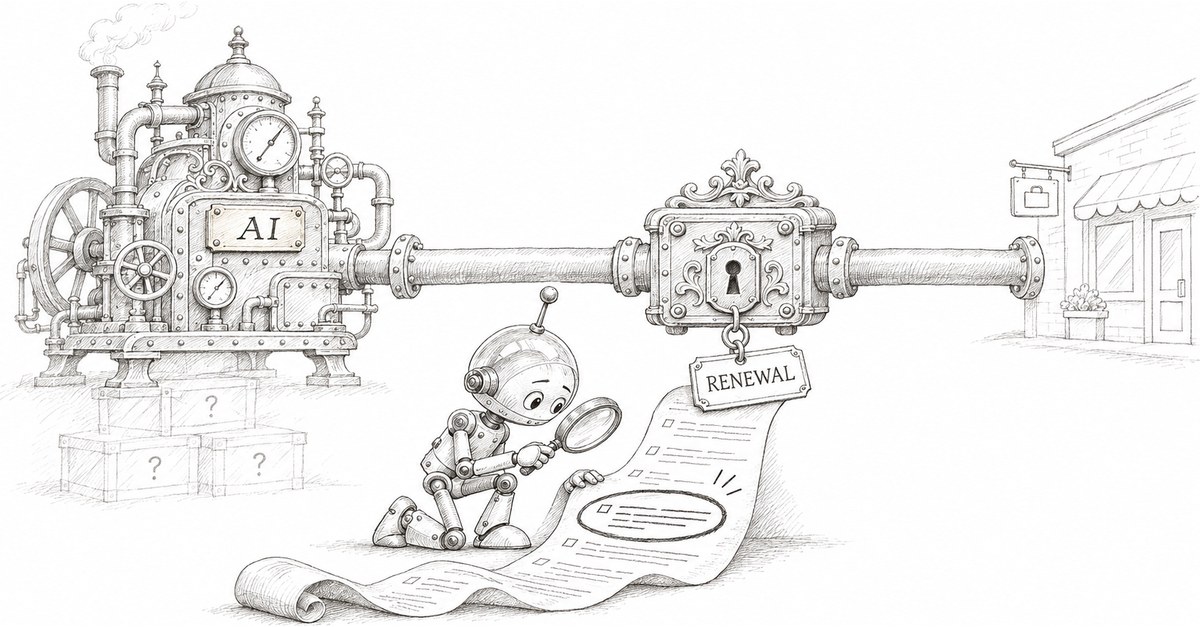
A large share of the “AI boom” is two companies spending each other’s money. Microsoft’s own FY2026 filings show $24.1bn of its revenue - about 7.26% of the whole company - came from commercial arrangements with OpenAI alone, roughly 70% of Microsoft’s AI-specific revenue. Amazon’s Q2 2026 results carry a $53.4bn non-operating gain tied to its stake in Anthropic. Commentator Ed Zitron has argued, in a widely-discussed August 2026 essay, that 70-75% of hyperscaler “AI revenue” reduces to these two customers spending investment money straight back on cloud compute - a circularity that gets booked as growth either way. None of this means AI tools stop working tomorrow. It means the vendor you’re about to sign a multi-year contract with may be more financially fragile than the pitch deck implies, and most mid-market contracts currently say nothing about what happens if it is. This post sets out what your renewal clause should cover, and why now is the moment to add it.
Why Does a Supplier’s Balance Sheet Suddenly Matter to a Marketing Team?
Because for the first time, the supplier and the infrastructure underneath it might be the same financial story.
When you bought a CRM or an email platform, its survival was a separate question from the survival of AWS or Azure underneath it. With a lot of today’s AI tooling, that separation has quietly disappeared. The model layer your vendor’s product runs on, the cloud compute that powers it, and the venture and hyperscaler money funding both, are increasingly the same small circle of companies. If one link in that circle wobbles, the wobble doesn’t stay contained to a headline. It reaches your renewal invoice.
This isn’t a reason to panic. It’s a reason to read the contract you’re about to sign the way you’d read any supplier agreement your business depends on - which, for most AI tools bought in the last two years, nobody has yet done.
How Much of “AI Revenue” Is Really Two Companies?
More than the marketing suggests, and this time there’s a hard number to point to.
Microsoft’s own FY2026 filings - not a commentator’s estimate, the company’s own disclosure - show $24.1bn of its total revenue came from commercial arrangements with OpenAI, about 7.26% of Microsoft’s $331.8bn total revenue and estimated at roughly 70% of Microsoft’s AI-specific revenue on its own. Microsoft is also carrying $6bn in OpenAI accounts receivable on its books. Amazon’s Q2 2026 SEC filing shows a $53.4bn non-operating gain from its Anthropic equity stake, separate from AWS’s own AI infrastructure business, which it reports running at over $25bn annualised.
Technology commentator Ed Zitron has gone further, arguing in an August 2026 essay that across all three major hyperscalers, 70-75% of what gets reported as “AI revenue” reduces to OpenAI and Anthropic spending hyperscaler and investor money straight back on hyperscaler compute - a circular arrangement in which the same pound (or dollar) gets counted as both an investment and a sale. That specific figure is Zitron’s own estimate and isn’t independently verified here. But the confirmed, company-reported numbers above point in the same direction: a meaningful share of the AI industry’s headline growth currently depends on two customers, not a broad market.
That concentration is the risk, whatever the precise percentage turns out to be. A market with thousands of buyers can absorb one buyer’s trouble. A market that quietly depends on two can’t.
Are OpenAI and Anthropic Actually Losing Money?
One of them clearly was in 2025. The other says it’s turned a corner, with a caveat worth reading twice.
OpenAI’s FY2025 financials, leaked and independently verified by the Financial Times, show $13.07bn of revenue against a $20.92bn operating loss - a company spending well over a dollar and a half to earn one, before the accounting effects of its non-profit-to-for-profit restructuring pushed the net loss higher still. Reported 2026 figures put OpenAI on roughly $25bn annualised revenue with a projected loss in the region of $14bn for the year - improving, but still a business that spends far more than it takes in.
Anthropic’s trajectory in 2026 has moved the other way. Revenue run-rate was reported at $30bn in April, rising to $47bn by late May, with Q2 2026 revenue of $10.9bn, more than double the previous quarter. Anthropic is now projecting its first operating profit - around $559m for the quarter - a genuine reversal from earlier guidance that pointed to no full-year profit before 2028. Anthropic itself has flagged that this may not hold for the full year given planned compute spend. That caveat, from the company’s own guidance, is worth taking as seriously as the headline.
Neither of these is a mature, settled business yet. One is losing money at scale. The other has had one good quarter and says so, carefully. Both are the counterparties behind a meaningful share of the AI tools currently being pitched into mid-market contracts.
What Happens When an AI Vendor You Depend On Fails?
It’s already happened, and the businesses left holding the mess didn’t get a say in the timing.
Builder.ai is the clean example. A UK-based, Microsoft- and Qatar Investment Authority-backed AI development platform valued at around $1.5bn, it entered insolvency on 20 May 2025 after a revenue-misreporting scandal that saw its reported 2023 revenue restated from $220m down to $140m. Hundreds of client projects were left incomplete, with no meaningful recourse for the businesses that had built on the platform. It wasn’t a niche player. It was a well-funded, well-connected vendor that mid-market buyers had every reason to trust - right up until they couldn’t.
It’s not an isolated case, either. Business shutdown tracker SimpleClosure’s H1 2026 report found AI companies made up 14.4% of all tracked start-up closures in the first half of the year - roughly one in seven. Most of those closures won’t make the trade press. Most of the businesses affected by them won’t have a data-portability clause to fall back on, because most AI contracts signed in the last eighteen months don’t have one.
None of this is an argument against buying AI tools. It’s an argument for buying them the way you’d buy any supplier your revenue depends on: with an exit plan agreed before you need it, not negotiated in a panic after the vendor’s gone quiet.
What Should Be in an AI Vendor Contract Before You Sign?
Four clauses, none of them exotic, all of them absent from most AI contracts currently in force.
- Data portability, properly scoped. Not a generic “you can export your data” line, but a clause covering your raw inputs, your usage history, and - where relevant - any model fine-tuning or configuration you’ve paid to build up. Ask what format it comes out in, and whether that format is actually usable elsewhere.
- A minimum deprecation notice period. Model versions and features get retired; the question is whether you find out with ninety days’ warning or an email the morning it happens. Get a specific number of days in writing, not “reasonable notice”.
- A price-lock or capped-increase term for the length of the contract. A vendor burning cash at OpenAI’s rate has an obvious incentive to raise prices faster than a mature SaaS business would. Cap it before you sign, not at renewal.
- Escrow, for anything business-critical. If a tool sits on your critical path - customer-facing, revenue-generating, or holding data you can’t easily reconstruct - a source-code or data escrow arrangement that survives the vendor’s insolvency is standard practice for critical suppliers in every other category. There’s no reason AI vendors should be exempt from it.
None of these clauses cost the vendor anything to grant if they’re confident in their own survival. A vendor who resists all four is telling you something about how confident they actually are.
Does This Change Whether You Should Be Buying AI Tools at All?
No - it changes how, not whether.
We’ve made the case elsewhere on this blog that the question for most mid-market businesses is no longer whether to adopt agentic AI, but when and how. That case hasn’t weakened. We’ve also written about the four-question test for telling a genuinely agentic product from a relabelled chatbot - Gartner’s own prediction that over 40% of agentic AI projects will be cancelled by 2027 sits in the same territory as this post: not a reason to stop, but a reason to vet the vendor as carefully as the technology.
Vendor financial risk and vendor technical risk are two separate checks, and most buying processes currently run neither. Our piece on why 45% of AI marketing tools fail to meet expectations found the majority of failures traced back to poor implementation and unclear success metrics, not the underlying model. Add vendor solvency to that list and the pattern holds: the technology is rarely the problem. The due diligence around it usually is.
If your business is mid-way through consolidating a sprawling martech stack into a single connected system, this is the moment to run the vendor-risk check on every AI tool that survives the cut, before you sign the renewal that locks it in for another year.
The Bottom Line
The concentration numbers are real, whichever version you use: Microsoft’s own $24.1bn from one customer, Amazon’s $53.4bn gain tied to another, or Zitron’s more contested 70-75% estimate across the industry. What’s not contested is that a meaningful share of AI infrastructure spending currently depends on two companies, one of them still losing money at scale, the other with one good quarter under its belt. That’s not a reason to stop buying AI tools. It’s a reason to buy them like you’d buy from any supplier whose survival isn’t guaranteed - with portability, notice periods, price caps and escrow written down before you need them, not negotiated after the fact.
Ask for the four clauses before the renewal, not after the vendor’s gone quiet.
Frequently Asked Questions
What is the “AI bubble” argument, in plain terms?
The argument, made most forcefully by commentator Ed Zitron in August 2026, is that a large share of the AI revenue hyperscalers report is really two companies - OpenAI and Anthropic - spending investment money straight back on cloud compute, which then gets booked as growth. Strip that circularity out and the underlying demand looks smaller and more concentrated than the headline numbers suggest.
How much of hyperscaler AI revenue really comes from OpenAI and Anthropic?
The clearest hard number is Microsoft’s own: its FY2026 filings show $24.1bn of total revenue - about 7.26% of the company - came from commercial arrangements with OpenAI alone, estimated at roughly 70% of Microsoft’s AI-specific revenue. Amazon’s Q2 2026 results show a $53.4bn non-operating gain tied to its Anthropic stake. Zitron’s own estimate of 70-75% of hyperscaler AI revenue across all three majors is not independently verified here, but the direction of travel in the confirmed numbers agrees with it.
Are OpenAI and Anthropic actually losing money?
OpenAI’s leaked FY2025 financials, verified by the Financial Times, show $13.07bn of revenue against a $20.92bn operating loss. Anthropic’s picture has moved the other way in 2026 - Q2 revenue of $10.9bn and a projected first operating profit, though the company itself has cautioned that may not hold for the full year given planned compute spend. Neither company is a settled, mature business yet.
What happens to my AI tools if a vendor fails or is acquired?
It depends entirely on what your contract says, which is exactly the problem - most SME contracts say nothing. Builder.ai, a UK-based, Microsoft-backed AI development platform valued at $1.5bn, entered insolvency in May 2025 after a revenue-misreporting scandal, leaving hundreds of client projects incomplete with no clear recourse. Roughly one in seven start-up closures tracked in H1 2026 was an AI company. It happens, and when it does, the businesses with an exit clause fare very differently to the ones without one.
What should be in an AI vendor contract before I sign?
Four things worth asking for by name: a data portability clause covering your raw inputs and any fine-tuned outputs, not just a generic export button; a minimum notice period before any model or feature is deprecated; a price-lock or capped-increase term for the contract length; and, for anything business-critical, a source-code or data escrow arrangement that survives the vendor’s insolvency. None of this is exotic. It’s the same due diligence you’d apply to any supplier your business depends on.
Does this mean businesses should avoid AI tools altogether?
No, and that’s not the argument. Aandai’s own position, covered elsewhere on this blog, is that agentic AI is already delivering real results for businesses that vet it properly. The point here is narrower: treat the vendor’s financial stability as part of that vetting, the same way you would for any other supplier your revenue depends on, and put the terms in writing before you need them.
References
- Microsoft Reveals It Generated $24.1 Billion in Revenue From OpenAI in Fiscal 2026 - Neowin, August 2026, reporting on Microsoft’s own FY2026 filings
- Amazon Q2 2026 Form 8-K exhibit, reporting the non-operating gain tied to its Anthropic equity stake - SEC EDGAR filing
- The AI Demand Bubble - Ed Zitron, 4 August 2026 (source for the 70-75% hyperscaler concentration estimate; commentary, not independently verified here)
- OpenAI’s leaked financials reveal $20.9bn operating loss on $13bn revenue in 2025 - Fortune, 16 June 2026
- Anthropic on Track for First Operating Profit as Revenue Surges - PYMNTS, 2026
- Builder.ai’s Collapse: AI Hype Fuels $1.5B Start-up’s 2025 Bankruptcy - WebProNews, 2025
- SimpleClosure Releases H1 2026 Shutdown Report - Business Wire, 20 August 2026
- Gartner Predicts Over 40% of Agentic AI Projects Will Be Canceled by End of 2027 - Gartner, 25 June 2025
Marc Price is the founder of Aandai, a B2B automation and AI consultancy helping mid-market businesses achieve more with less. With 24+ years in B2B technology marketing and web development, Marc specialises in connecting legacy systems, eliminating manual processes, and implementing practical AI solutions that deliver measurable ROI. Aandai runs its own agentic stack on OpenClaw to automate parts of its consultancy delivery - including the research and vendor checks that informed this article.