· Marc Price · ai-strategy · 9 min read
Everyone Is Using AI. Why Are Only 39% Seeing Results?
95% of B2B marketers now use AI, but only 39% say it improves performance. The gap is not the tools. It is where they are plugged in - and what the 6% getting 22% gains do differently.
TL;DR
Nearly every B2B marketing team now uses AI. 95% use it somewhere in their workflow, yet only 39% say it is actually improving performance. That is not a tools problem. McKinsey’s 2026 survey of European marketing leaders found just 6% have mature generative AI use, and those few report 22% efficiency gains and reinvest this in growth. The difference is not budget or model choice, it is whether AI is wired into a named workflow with an owner and a baseline, or left as a scattering of individual experiments. This post sets out what the gap looks like, why licences alone do not close it, and five steps to move one workflow from “using AI” to “AI working”.
Why does nearly everyone use AI, yet most see little from it?
Because using a tool and changing a workflow are different things, and only one of them shows up on the P&L.
Your team is capable and your tools are good. Nothing here is a criticism. The rules changed quickly, and the easy part, trying the tools, well that came first. The Content Marketing Institute’s 2026 B2B research (1,015 marketers) found 95% now use AI in at least one part of their workflow. And only 39% say it is improving performance.
HubSpot’s data tells the same story from a different angle… 26.5% of marketers report a significant productivity gain from AI. A further 66.2% report a slight or moderate one. Those people are getting something back, a quicker first draft or a tidier summary, and then it vanishes into the rest of the week.
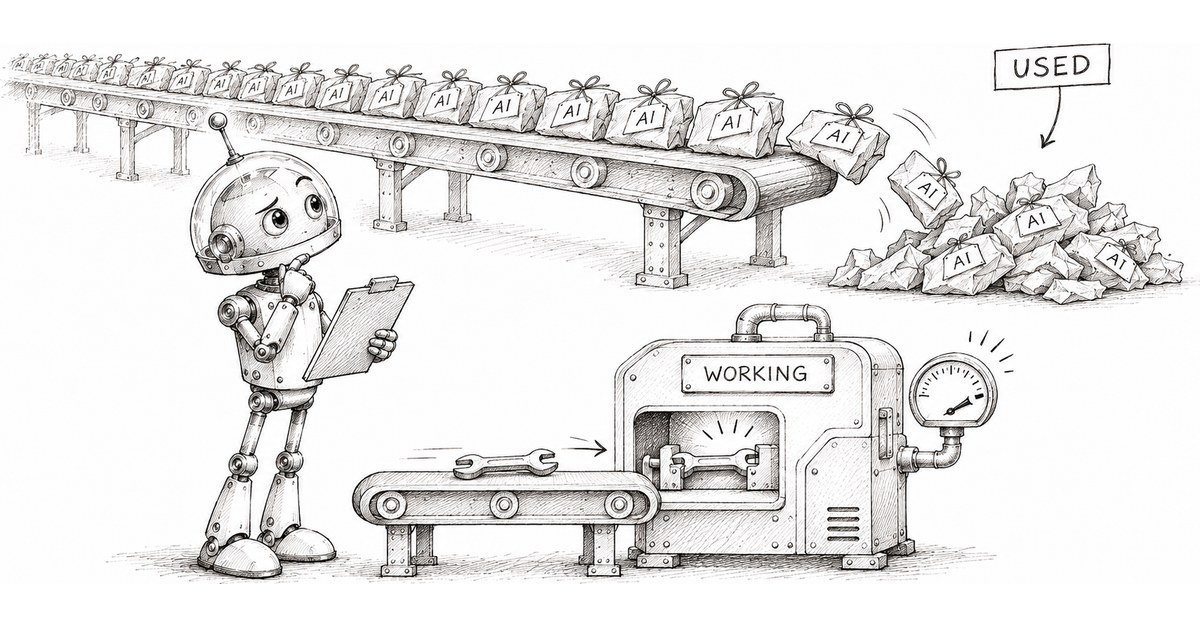
Adoption is a number someone can report. Impact is a number someone has to defend. That is why the first is everywhere and the second is rare.
What does the 6% do differently?
Put simply, they stopped experimenting and started operating.
McKinsey’s State of Marketing Europe 2026 surveyed 500 marketing leaders across the UK, France, Germany, Italy and Spain. 94% have not yet advanced their generative AI maturity, which McKinsey attributes to cautious leadership, limited know-how and scattered initiatives. The roughly 6% that have report 22% efficiency gains, expect 28% within two years, and tend to reinvest the gains in growth rather than cut people.
Two details really matter here. First, that 22% applies only to that mature group, not to the overall market. Anyone quoting it as an average is flattering the average. Second, generative AI ranked only 17th of 20 priorities for the coming year in the same survey. The majority are not even planning to close the gap. That’s the opportunity, and the warning.
What the mature few share is dull… One owner per workflow. A baseline taken before anything changes. AI embedded where the work happens rather than bolted on beside it. It is the same pattern we described in the CFO’s guide to marketing AI: the pilots that prove ROI name a financial metric first. The ones that do not, drift.
Why don’t more licences close the gap?
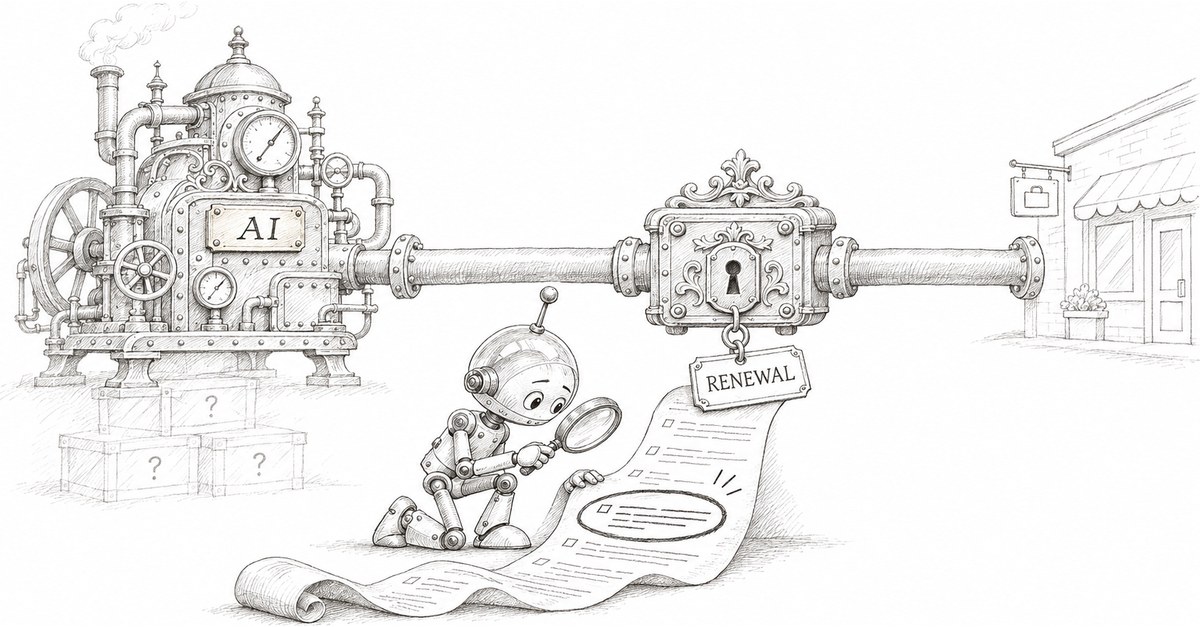
Because the gap is in the plumbing, not the seat count.
Give ten people ten AI subscriptions and you get ten private ways of working, none of which can be measured, shared or improved. One person’s brilliant prompt leaves with them. Another’s output gets rewritten by hand because nobody trusts it. The tool is used. The process remains unchanged.
Three patterns account for most of the shortfall:
- Disconnected from the data. The AI works from whatever the user pastes in, not from your CRM, your content or your decisions. Output is generic, so it needs heavy editing, so the saving disappears.
- No owner, no baseline. Nobody measured the workflow before. After six months, “it feels faster” is the only evidence on offer, and it will not survive a budget review.
- No memory. Every session starts from zero. We covered this in what we mean by a business brain: an AI that forgets on Tuesday what it learned on Monday does day 400 exactly as it did day 4.
None of these is fixed by a better model. All three are fixed by deciding, once, where the AI sits in the work and who answers for it.
What should you be careful of as you embrace AI more?
Counting the wrong thing, and mistaking motion for progress.
Three traps are worth naming:
- Celebrating adoption. “80% of the team used the tool this month” is a statement about attendance. Ask what changed in cycle time, error rate or cost.
- Automating a bad process. A faster version of a workflow nobody trusted is still a workflow nobody trusts. Fix, then speed up.
- Letting it act unsupervised too early. Draft first, human approves, autonomy earned one workflow at a time. Gartner’s survey of 402 CMOs found AI automates 16% of marketing work today, and leaders expect 36% by 2028. That is a doubling of what machines do on your behalf. The review step is what keeps a doubling from becoming a liability.
Reading the market honestly also means resisting the other extreme. Our post on the make-work tax made the point from the cost side: much of the week goes on upkeep nobody budgeted for. AI is the best chance most teams have to take that time back. It only does so when it is pointed at the upkeep.
How do you move one workflow from “using AI” to “AI working”?
Pick one, and treat it like a small operational project.
- Choose a workflow with a pattern and a paper trail. Weekly reporting, inbound enquiry triage, first-draft proposals, CRM hygiene. Repetitive, frequent, and annoying enough that people will notice when it improves.
- Baseline it for 30 days. Three numbers: hours spent, error or rework rate, time from start to finish. Do not change anything yet.
- Give it one owner. A named person who is accountable for the result, not for the tool.
- Connect it to your own data. The AI should work from your records and your decisions, not from a blank page. This is where most of the quality comes from.
- Draft first, review, then measure again at 90 days. If the numbers moved, widen it. If they did not, you have learned something cheaply.
Run that once and you hold something most of the 95% do not: a number you can defend. Run it four times across the year and you are building the kind of programme McKinsey’s 6% describe.
The Bottom Line
The question is no longer whether your team uses AI. They do, and so do your competitors. The question is whether any of it is wired into work that someone owns and measures.
If the honest answer is “mostly experiments”, you are in good company: 94% of European marketing organisations are there too. But the way out is not another subscription. It starts with just one workflow, one owner, one baseline.
Start with one this month. Measure it before you touch it. And be wary of any vendor who wants to talk about adoption when you want to talk about results.
If you would like help picking the first workflow and setting its baseline, that is a short piece of work we do regularly. Book a discovery call and we will map it with you.
Frequently Asked Questions
How many B2B marketers actually use AI, and how many say it works?
Content Marketing Institute’s 2026 B2B research found 95% use AI in at least one part of their workflow, but only 39% say it is improving performance. Adoption is close to universal. Results are not.
What do the businesses getting real gains do differently?
McKinsey surveyed 500 European marketing leaders in 2026. The roughly 6% with mature gen AI use report 22% efficiency gains and expect 28% within two years. They reinvest the gains in growth rather than headcount cuts, and they run joined-up programmes rather than scattered experiments.
Is “using AI” the same as AI being embedded in the work?
No. HubSpot’s 2026 trends data found 26.5% of marketers report a significant productivity gain from AI, and 66.2% report only a slight or moderate one. That second group is using AI and getting a little back. Embedding means the tool is wired into a named workflow with a named owner and a measured outcome.
How quickly will this gap matter?
Soon. Gartner surveyed 402 CMOs in 2026 and found AI automates 16% of marketing work today; leaders expect 36% by 2028. A business that is still at the dabbling stage when its competitors reach 36% will not close the distance by buying more licences.
What is the cheapest first step to close the gap?
Pick one workflow, measure it for 30 days before you change anything, and give it one owner. A baseline of three numbers - hours, error rate, cycle time - is enough. Without it you cannot tell a 5% gain from a 25% one, and neither can your CFO.
References
- Content Marketing Institute - B2B Content Marketing 2026 research (95% use AI in at least one workflow, 39% say it improves performance; 1,015 marketers), as reported by MarketScale, July 2026
- McKinsey - Past forward: The modern rethinking of marketing’s core (State of Marketing Europe 2026; 500 leaders; 94% yet to advance gen AI maturity; ~6% mature report 22% efficiency gains, expect 28%; gen AI ranked 17th of 20 priorities), 2026
- HubSpot - Marketing industry trends report (26.5% significant productivity gain from AI, 66.2% slight or moderate), 2026
- Gartner - Survey Reveals Marketing Leaders Expect AI Automation of Marketing Work to Double to 36 Percent by 2028 (402 CMOs; 16% today), May 2026
Marc Price is the founder of Aandai, a B2B automation and AI consultancy helping mid-market businesses achieve more with less. With 25+ years in B2B technology marketing and web development, Marc specialises in connecting legacy systems, eliminating manual processes, and implementing practical AI solutions that deliver measurable ROI. Aandai runs its own agentic stack on OpenClaw to automate parts of its consultancy delivery - including the research that informed this article.