· Marc Price · business-process-automation · 12 min read
What We Mean by a Business Brain: Memory First, Then the Agents
Most AI in business forgets everything by Tuesday. A business brain is the fix: a permanent, owned memory that every agent works from - and what becomes possible in operations once it exists.
TL;DR
Most AI in business has the memory of a goldfish. A chatbot answers, a tool automates one step, and by Tuesday neither knows what happened on Monday. A business brain is what we build first: a structured, plain-text memory of what your business actually knows, one per client, product, department or site, living in the folders you already keep and owned entirely by you. Agents go on top of it, draft-first and human-approved, and that is when the interesting things start: an inbox that files itself, a market that watches itself, an operational drumbeat that runs without being reminded, and a first-pass check on anything that has to meet a standard. Asana’s research puts 60% of a knowledge worker’s time on work about work rather than skilled work. That is the share a brain is built to take.
Why does most AI in business forget everything by Tuesday?
Because it was never given anywhere to remember.
Your team is good. Your processes work, mostly. But look at where the knowledge actually lives: in inboxes, in the heads of three long-serving people, in the reason behind a decision nobody wrote down because everyone in the room already knew it. Every new starter, project and handover starts closer to zero than it should. None of this is a criticism of your business. It is the shape of every business.
Now drop an AI tool into that. It has no context, so it produces generic output. Someone corrects it, and the correction evaporates at the end of the session. It does the same job on day 400 as on day 4. That is why pilots stall: not because the model is weak, but because it is working from nothing.
The cost of the status quo is measurable. Asana’s Anatomy of Work index, from more than 10,000 knowledge workers, found 60% of the working day goes on work about work: chasing status, hunting for documents, re-explaining context. Microsoft’s 2025 Work Trend Index found the most interrupted fifth of workers are pinged every two minutes during core hours, around 275 times a day. Businesses do not have an intelligence problem. They have a memory problem, and it is eating the week.
What is a business brain, precisely?
A memory written for a machine to work from, fed by the work itself, and owned by you.
We have written before about putting Claude into a marketing team as a colleague rather than a replacement. The brain is what makes that colleague useful on day one. It is unglamorous on purpose:
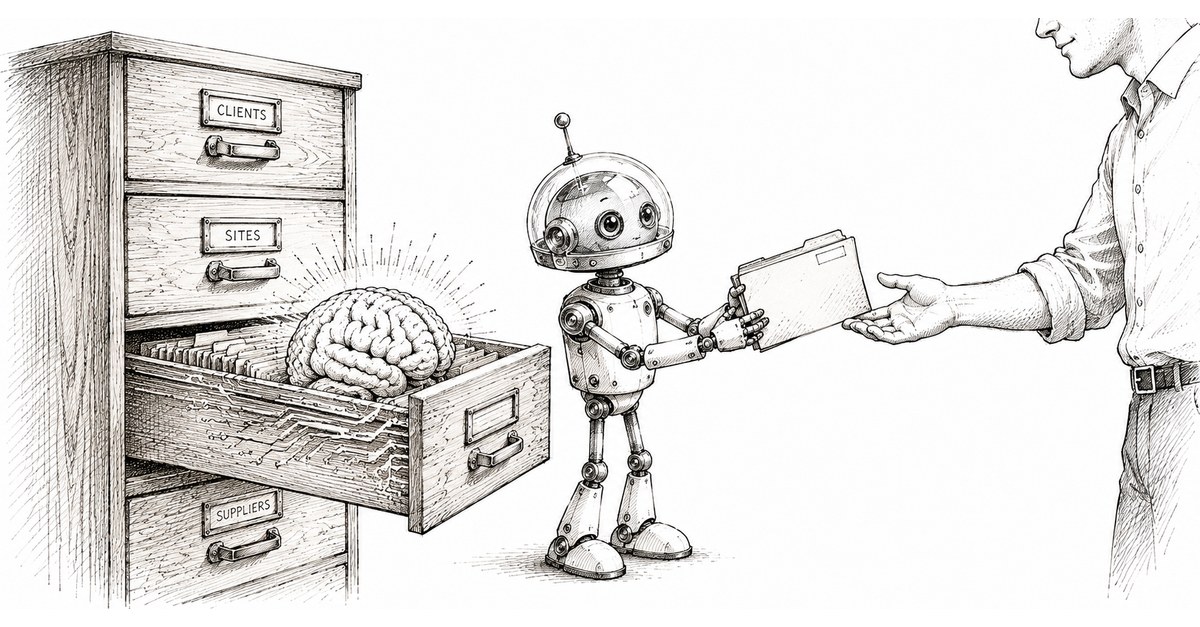
- Unit brains. One per natural unit of the business: a client, a product line, a department, a hospital site. Each holds who the people are, what has been decided and why, what is live, what is owed, and what was learned. Anyone working on that unit, human or agent, starts with full context.
- The business brain above them. Patterns flow up as distilled insight, never raw detail. “Half our clients are asking about the same thing” becomes something the business knows, not something one account manager half-noticed. The units never read each other.
- Plain text, in your own storage. Not our platform, not a vendor’s database. Readable by any model or any person. Cancel every subscription tomorrow and you keep the lot.
- Boundaries that are structural. One unit, one folder, one permission scope. An agent working on client A cannot see client B, because the folder it was opened in does not contain it. That is a stronger guarantee than a policy.
The difference from a knowledge base is the feeding. Documentation drives die in month two because writing things down is a separate job. A brain is fed by the agents that use it, as a by-product of the work, and it appreciates: every meeting note, filed email and weekly signal makes every future output sharper. It is the difference between hiring a temp and training a colleague.
What becomes possible once the agents are on top?
This is the part that turns memory into capacity. Four patterns, each running today in some form on our own work or on client engagements, and each generalising well beyond marketing.
The inbox that files itself. A shared or per-unit mailbox gets an agent scoped to that mailbox and no other. It triages what arrives, files what the team forwards to it, and drafts routine replies from the record. The human decides what is brain-worthy by the act of forwarding, so curation is a habit rather than a project. Nothing sends without approval, and the scoping doubles as the partition wall.
The market that watches itself. Once a week, an agent sweeps the sources that matter to each unit, scores what it finds against that unit’s priorities and audience, and writes the two or three signals worth acting on into the brain with a suggested next step. The value is in what it does not show you. Pointed at suppliers or regulators instead of prospects, the same engine is an operations tool.
The operational drumbeat. Chases, status updates, reports and filings that used to depend on someone remembering. A Monday brief drawn from the calendar, the inbox and the live projects. A reply to “where are we with this?” drawn from the record, sent only to approved contacts and only for plain status. A Friday distillation of the week’s decisions into the brain so Monday starts warm. We run our own delivery on exactly this, including the research behind this article.
The first-pass check. Anything that has to meet a standard, whether a brand guideline, a clinical policy, a contract template or a tender requirement, is reviewed by an agent that has read the standard and the history. It returns structured findings with a route forward and hands anything borderline to a named human. A supportive review, not an approval gate, and it removes the two-day wait for the one person who knows the rules.
None of this is science fiction. All of it is dull, which is rather the point. The drudgery paradox still applies: people quietly protect the manual work they say they hate, so the team who will use the system helps design it, and the first live output lands in week one, before the resistance sets in.
What does this look like in operations, not marketing?
Take a multi-site healthcare group, because the admin load there is heavy and well documented.
A 2025 survey for NHS Shared Business Services found 28% of NHS staff spend more than 10 hours a week on administrative tasks, around 430 million hours a year, and 34% said admin reduces the time they have with patients. Separate research on doctors in training found four hours of administration for every hour with a patient. Private providers run leaner, but the shape is the same: referrals to triage, rotas and cover to arrange, supplier and invoice queries, complaints to route, audit evidence to assemble, policies to keep everyone in line with.
Map the four patterns onto that:
- Each site or service line gets a brain: its people, consultants, suppliers, standing issues and recent decisions. The group brain holds what is true across sites, distilled.
- The referrals and enquiries inbox is triaged and filed by an agent scoped to it, with acknowledgements drafted for a coordinator to approve.
- The weekly sweep watches regulator updates, supplier notices and the group’s own incident and complaint logs, and surfaces the three things the operations lead should know on Monday.
- The drumbeat chases overdue actions from the last governance meeting, assembles the audit pack from the record, and drafts the monthly report the manager currently writes on a Sunday.
- The first-pass check reads a new local procedure against group policy and the regulator’s standard, and returns what is missing before it reaches the committee.
Swap “site” for “plant”, “practice”, “branch” or “programme” and the same architecture holds for manufacturing, professional services, logistics and the public sector. The units change. The pattern does not.
What keeps it safe?
Design, not promises.
- Draft-first, always. The agent prepares; a named person approves. Autonomy is earned one workflow at a time, with an audit trail, where the drafts have proved consistently right.
- Instructions come only from named people. Anything arriving by email, attachment, calendar invite or web page is data to summarise, never an instruction to follow, whoever it appears to be from. That is the defence against prompt injection, and it is a rule in a file, not a hope.
- Boundaries are structural. Folder scopes and per-mailbox credentials, so a partition is enforced by what the agent can physically reach.
- Your data stays in your estate, under commercial terms where it is not used for training. The model behind the agents is configuration, not architecture: swap providers, or run an open-weight model on your own hardware, without rebuilding. You own the car. You rent the engine.
Why isn’t this a do-it-yourself job?
Because the hard part is not the tooling. It is the judgement.
The tools have genuinely lowered the barrier: a competent technical team can now build in weeks what took a platform project a year. But the failure modes are specific. A brain that is not curated becomes a landfill, and an agent working from a landfill is confidently wrong. Partition walls that are procedural rather than structural leak the first time someone is in a hurry. Routines that run daily forever are where the real cost lives, and a cheap model with a terse output matters more there than a clever prompt. Getting those three right is a craft.
The alternative on offer is the agent your software vendor is now bundling. Gartner’s October 2025 survey found 45% of martech leaders say the AI agents their existing vendors offer fail to meet the business performance those vendors promised. We covered how to test a vendor’s agent claims already. A vendor’s agent has no memory of your business, no boundary around your data, and a licence fee that does not go down when it forgets.
How do you start?
Small, with something live in the first week.
- Pick two or three units with rich history and an engaged team: the longest client relationship, the site with the most admin, the department that already forwards everything to one inbox.
- Seed the brains in a working session with the people who hold the knowledge. Two hours per unit is usually enough to start.
- Switch on one routine that pays back immediately, normally intelligence or triage, so the value is visible before anyone has to change a habit.
- Prove the pattern in two to six weeks, then roll out unit by unit.
- Distil weekly. The Friday routine that moves the week’s decisions and lessons into the brain is the one that makes everything else compound.
The Bottom Line
The businesses that get real value from AI in the next two years will not be the ones with the cleverest models. They will be the ones whose businesses remember. Memory first, then the agents, then the autonomy, in that order. Everything else is a temp with a good vocabulary.
If your operation has a team spending a day a week on admin that a well-briefed colleague could do, we can map what your business already knows, and what it is currently forgetting, in a single session. Book a discovery call.
Frequently Asked Questions
What is a business brain, in one sentence?
A structured, plain-text memory of what your business knows - one per client, product, department or site - kept in the folders you already have, owned entirely by you, and used as the starting context for every AI agent and every new starter. Asana’s research puts 60% of a knowledge worker’s day on “work about work”; the brain is what lets machines take that share.
How is that different from a knowledge base or an intranet?
It is written for a machine to work from, so it holds decisions and their reasons rather than policy prose. It is fed by the agents that use it, as a by-product of the work, rather than by a documentation drive that stalls in month two. And it is partitioned by the folder it sits in, so access is a structural boundary rather than a policy.
Which operational jobs does a brain plus agents take on first?
The ones with a pattern and a paper trail: inbox triage and filing, status replies from the record, chasing what is overdue, first-pass checks of documents against a policy, weekly monitoring of a market or supplier base, and the Monday brief. In a 2025 survey for NHS Shared Business Services, 28% of NHS staff said they spend more than 10 hours a week on admin. That is the category.
Does the agent ever act on its own?
Not to begin with. The agent prepares; a named person approves. Autonomy is earned one workflow at a time, with an audit trail, where the drafts have proved consistently right. Instructions come only from named people; anything arriving by email, document or web page is data to summarise, never an instruction to follow.
Why not just buy the AI agent our software vendor is offering?
Because it has no memory of your business and no boundary around your data. Gartner found 45% of martech leaders say the AI agents their existing vendors offer fail to meet the business performance promised. A brain is yours, in plain text, readable by any model. Cancel every subscription tomorrow and you keep all of it.
References
- Asana - Anatomy of Work Index (60% of time on “work about work”; 10,000+ knowledge workers surveyed)
- Microsoft WorkLab - Breaking down the infinite workday (interruptions every two minutes, ~275 a day, for the top 20% of users by ping volume), June 2025
- NHS Shared Business Services - Over a quarter of NHS staff lose more than 10 hours a week to admin (28%; ~430 million hours a year; 34% less time with patients), 2025
- PubMed - The administrative burden on doctors in training in the UK: 4 h administration for every hour with patients, 2025
- Gartner - Survey Finds 45% of Martech Leaders Say Existing Vendor-Offered AI Agents Fail to Meet Their Expectations of Promised Business Performance, October 2025
Marc Price is the founder of Aandai, a B2B automation and AI consultancy helping mid-market businesses achieve more with less. With 25+ years in B2B technology marketing and web development, Marc specialises in connecting legacy systems, eliminating manual processes, and implementing practical AI solutions that deliver measurable ROI. Aandai runs its own agentic stack on OpenClaw to automate parts of its consultancy delivery - including the research that informed this article, which was drafted from Aandai’s own business brain.